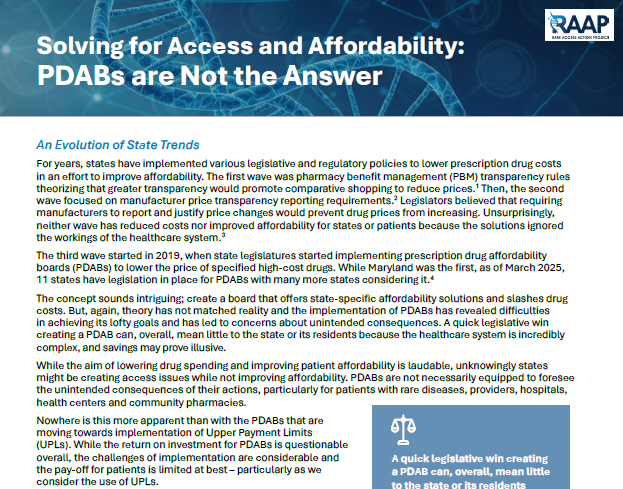
Today a paper I’ve been working on for a while with the Rare Access Action Project (RAAP) is unleashed — well timed for NCSL in Boston. It isn’t that prescription drug affordability boards (PDABs) are bad, I just don’t think they can meet their objectives. I’m excited for this paper to come out highlighting why upper payment limits are doomed to fail and the executive summary focused on the potential impact of PDABs for those with rare diseases. For those of you who subscribe to my news updates, this is also a heads up that I’ll be moving to a Substack for distribution starting this Friday. But more on PDABs…
Theory has not matched reality and the implementation of PDABs has revealed difficulties in achieving its lofty goals and has led to concerns about unintended consequences. A quick legislative win creating a PDAB can, overall, mean little to the state or its residents because the healthcare system is incredibly complex, and savings may prove illusive.
PDABs are not necessarily equipped to foresee the unintended consequences of their actions, particularly for patients with rare diseases, providers, hospitals, health centers and community pharmacies. Nowhere is this more apparent than with the PDABs that are moving towards implementation of Upper Payment Limits (UPLs). While the return on investment for PDABs is questionable overall, the challenges of implementation are considerable and the pay-off for patients is limited at best – particularly as we consider the use of UPLs.
Apteka worked with RAAP (the Rare Access Action Project) to dive into the world of PDABs and UPLs to illustrate why they haven’t gone the way legislators hoped and why they are a threat to patients, particularly those with rare disease.
Link to Executive Summary (Focused on PDABs and Rare Disease)

